Academics that move with you
A dual curriculum of Judaic and General Studies, three tracks in every course, and the freedom to move up the moment you're ready.
Met where you are, then challenged further
WHHS pairs a rigorous General Studies curriculum (Regents-accredited) with serious Judaic learning. Small classes, an average of 6–12 students, mean a teacher always knows where you are and where you're headed.
WHHS is committed to academic excellence through relevant, innovative, context-based learning. Teachers collaborate to integrate a curriculum that combines academic knowledge, critical reflection, and college preparedness.
Academics here connect to real-world scenarios. Students are encouraged to take what they learn in the classroom and become active members of the community beyond our school walls.
No permanent labels. No ceiling.
Every Judaic and General Studies course is offered at three levels, and students move freely between them at any time of year, in any subject. Why wait four more years for the tools educators agree work best?
Honors
Accelerated depth and pace for students ready to stretch, available from 9th grade.
Standard
A strong, college-preparatory core taught in small, personal classes.
Support
Built-in scaffolding through the Learning Center, with no pull-out and no missed classes.
Move up a level the moment you're ready. Your placement is never fixed.
The numbers behind the program
Regular, Honors and AP
A college-preparatory dual curriculum, required of every student. General Studies courses are offered at Regular, Honors and Advanced Placement levels. Judaic courses in Bible, Navi and Talmud are offered at Regular and Honors levels. WHHS is registered by the New York State Board of Regents.
Advanced Placement courses
The school year runs in four quarters of about ten weeks, with midterms in late January, AP exams in May, and finals and Regents in June. WHHS does not rank students, and grades are not weighted.
Electives
Full descriptions are in the course catalog below.
Course catalog, by department
Course descriptions from each department. Offerings and reading lists can change from year to year.
Judaic Studies
Our Judaic Studies curriculum centers on Torah in our lives. We make Torah relevant and meaningful, building a love for learning and a deep connection to Torah values through skill building, questioning and analysis of the primary texts of our tradition. Over four years students build a solid knowledge base in Tanach, Talmud, classical Jewish literature and Jewish history. Bible, Navi and Talmud are offered at Regular and Honors levels.
The Ikarim Program
The foundation for Jewish learning in high school and beyond: a clear perspective on Jewish history, its key events, people and places, and an understanding of the halachic process.
Chumash
A four-year cycle through Bereshit, Shemot and Bamidbar, framed each year by “big ideas” such as leadership and the nature of sin. Students examine text and concepts, formulate meaningful questions, compare classical and more recent commentaries, and apply what they learn to everyday life.
Nevi’im and Ketuvim
Sharpens exegetical and literary skills through the latter prophets and books of Ketuvim, with themes such as leadership, prophecy, teshuva, chessed and Eretz Yisrael, using commentaries including Metzudat Tzion, Radak and Abarbanel. Each unit closes with relevant topics in Jewish law.
Gemara
Tractates Berachot, Yoma, Kiddushin and Rosh Hashana with Rashi, Tosafot and later commentaries, the depth set by each class’s level. Each topic is brought down to halacha, “What do we do?”, across themes such as tefilah, mezuzah, pikuach nefesh, galut and the Jewish calendar.
Advanced Talmud Studies
A rigorous course taught in Hebrew. Students finish a full tractate in 9th and 10th grades, mastering reading, translating and analyzing Gemara and Rashi, then focus on the twelve central sugyot of Shas in 11th and 12th, with an emphasis on sevara and in-depth halachic analysis. Graduates are ready for Israel’s top yeshivot.
Mechina
For students with little or no day-school background or Hebrew. This two-year program teaches conversational and grammatical Hebrew and the fundamentals of Judaism, its study and practice, and integrates students into regular Judaic Studies classes, some even sooner.
English
English at WHHS is built around themes that grow with students over four years, with Shakespeare and memoir in every grade and college essay writing in 11th and 12th. English is offered at Regular, Honors and AP levels.
Ninth Grade English
Why do we tell stories, and how do they shape who we become? Students explore heroes and quests, coming of age, injustice and protest, and memoir. Texts include The Hate U Give, The Hunger Games and selected Greek myths, The Curious Incident of the Dog in the Night-Time, Lord of the Flies, Romeo and Juliet, Night and Of Mice and Men.
Tenth Grade English
How do culture, war and community shape the individual? Students read memoir, war narrative and dystopian fiction, and study how power corrupts through Shakespeare’s leaders. Texts include Born a Crime, Unbroken, Miss Peregrine’s Home for Peculiar Children, Macbeth, Brave New World and Maus or Persepolis.
Eleventh Grade English
American literature and the American experience: fear and conscience, courage under pressure, social class and the promise of the American Dream. Texts include The Help, City of Thieves, The Crucible, The Great Gatsby, Death of a Salesman or Fences and The Things They Carried. The year ends with personal narrative writing in preparation for the college essay.
Twelfth Grade English
Seniors open the year by completing a polished college essay, then turn to questions of justice, power and individuality. Texts include The Perks of Being a Wallflower or The Bluest Eye, A Study in Scarlet, 1984, King Lear or Othello and One Flew Over the Cuckoo’s Nest.
AP English Language and Composition
How a writer’s purpose, audience, subject and genre interact. Students become critical readers of non-fiction and write expository, argumentative and analytical essays of their own.
History
History begins with the foundations, ideas and geography behind the development of the world, then moves to interpreting primary sources and writing document-based essays. Students learn to think critically and take part in civic life. Jewish history is woven through the curriculum, and art and literature are studied in their historical context. History is offered at Regular, Honors and AP levels.
Global History I
From the birth of civilization through the ages before the Industrial Revolution: a cross-cultural, chronological journey with an emphasis on key concepts, skills and the comparative analysis of ancient civilizations. Students research and present in writing and orally.
Global History II and AP Global History
The modern world from the Age of Revolutions to the present: the Renaissance, the growth of democracy, nationalism and imperialism, and modern world history, with attention to the role of the Jewish people in Western civilization. Qualified students take AP Global History.
U.S. History and AP U.S. History
The United States from the colonies to the present: the origins of American democratic institutions and the challenges they have faced, taught through primary sources and multimedia. Honors students take AP U.S. History, with an emphasis on document-based analysis.
U.S. Government & Politics and AP U.S. Government & Politics
The branches of government and how they interact with interest groups, the media, political parties and the bureaucracy. Honors students take AP U.S. Government & Politics, an intensive study of how policy is made and implemented.
Senior Jewish History Seminar
From the roots of antisemitism to the modern State of Israel. Seniors study the causes of the Holocaust and its history, the waves of aliyah that built the Yishuv, the founding and early years of the state, the role of religious Zionism, and what it means for Israel to be a Jewish state. The seminar prepares students to speak about Jewish history and Israel with knowledge and confidence on campus and beyond.
Mathematics
Mathematics builds confidence and problem-solving across algebra, geometry, statistics and financial math, with an emphasis on how each course builds on the last and on connections to other subjects and the real world. Courses follow and go beyond the New York State Regents syllabus, and students use graphing calculators and technology throughout.
Algebra I
Real numbers, linear and quadratic functions and systems, rational algebra, right-triangle trigonometry, statistics, probability and counting theory, focused on conceptual understanding and problem solving. For students who have not yet taken the Algebra I Regents.
Geometry
Geometric relationships, formal and informal proofs, triangles, polygons, circles, coordinate and transformational geometry, constructions and locus, with enrichment beyond the Regents syllabus.
Intermediate Algebra
A bridge between Algebra I and Algebra II. Students strengthen core algebra skills, then extend them to more complex equations, inequalities and functions, learning to solve problems and interpret what the answers mean. Hands-on activities and technology help build both understanding and fluency, preparing students for the next level of math.
Algebra II and Trigonometry
Rational expressions, radicals and complex numbers, functions, trigonometry, exponents and logarithms, sequences and series, probability and statistics, with advanced topics.
Pre-Calculus
Everything needed to succeed in AP Calculus or college calculus: modeling real-world phenomena, exponential and logarithmic functions, trigonometry, sequences and series, conic sections and an introduction to calculus.
AP Calculus AB
A college-level course on the two fundamental ideas of the derivative and the integral: techniques of differentiation and their applications, area under a curve and volumes of irregular shapes.
Business Math
The math behind daily financial decisions and running a business. Students work through personal finance, banking, investing, insurance, taxes and entrepreneurship, using real data, spreadsheets and hands-on projects. Along the way, they explore careers in business and finance and build the financial literacy they will use long after graduation.
Applied Topics in Math
A focused review and deeper look at key ideas from algebra and geometry, designed to prepare students for credit-bearing college math. Topics include rational numbers, area and volume, congruence and similarity, the Pythagorean theorem, sets and logic, ratio and proportion, and quadratic equations. Real-world problems connect each topic to science, economics and everyday life.
Science
Science at WHHS is built on hands-on discovery, from 9th-grade Biology through AP. See the science spotlight for what makes it distinctive: labs in every course and a campus on the Long Island Sound.
Biology
Life processes from the cell up: the scientific method, cell structure and division, genetics, evolution, classification, reproduction, human anatomy and ecology, with special emphasis on human structure and genetics. Hands-on labs build the microscope and lab skills used in every science course that follows.
Chemistry
Matter and energy, atomic structure, the periodic table, ionic and covalent bonding, chemical reactions, kinetics, equilibrium, gas laws, solutions, electrochemistry and organic chemistry, with labs designed to reinforce each major concept.
Earth & Space Science
How does our planet work, and where does it fit in the universe? Students study rocks and minerals, plate tectonics, weather and climate, the water cycle, and the solar system and beyond. Through labs, data and hands-on investigation, they learn to read the natural world around them, starting with the Long Island Sound outside our windows.
Introduction to Forensic Science
Chemistry, physics and biology applied to criminal and civil law: fingerprinting, fiber analysis, ballistics, trace evidence, blood spatter and DNA, and how samples are collected, preserved and analyzed in the lab.
General Physics
The fundamental laws behind how the world moves, from a thrown ball to an electric circuit. Students study mechanics, energy, waves, thermodynamics, electricity, magnetism and modern physics, building both conceptual understanding and mathematical problem-solving skills. Aligned with New York State Science Learning Standards, the course prepares students for advanced physics and future study in science and engineering.
Sports Science
The science behind athletic performance. Students explore how the body moves and responds to training, including anatomy, muscles and bones, the heart and lungs, nutrition and hydration, and injury prevention and recovery. Real examples from sports and students’ own activity make the study of biology and physics personal and practical.
AP Physics 1
An algebra-based, introductory college-level course built on inquiry-based lab work: systems, fields, Newtonian mechanics, force interactions, conservation and waves.
AP Biology
The equivalent of a first-year college biology course: biochemistry, cellular biology, heredity, molecular genetics, evolution, the diversity of organisms and ecology.
Hebrew (Ivrit)
Hebrew is much more than a foreign language here. In a lively, immersive classroom, students progress at their own pace in speaking, reading, writing and listening, through texts from traditional to modern, current events, poetry and Israeli pop music. Every Friday, classrooms become a בית קפה ישראלי, an Israeli coffee house, where students talk about current events in Hebrew.
Ninth Grade Hebrew
Everyday proficiency, from the restaurant to the bank to public transportation, with Israeli writers such as Bialik, Peretz, Agnon and Etgar Keret as a springboard for discussion, and Hebrew newspapers for current events.
Tenth Grade Hebrew
More complex conversation, including Israel’s technology boom, with literature on the history and geography of the State and pre-State aliyot, from Rachel, Amichai, Alterman and Bialik, plus Israeli songs, films and newspapers.
Eleventh Grade Hebrew
Identity, personal, national and religious: what it means to be Jewish, and how Israel is perceived, through poets such as Naomi Shemer and Ehud Manor. Students keep journals, give presentations and lead discussions.
Twelfth Grade Hebrew
Israeli film and television as a window on Israeli society, politics and the economy, with debates in Hebrew. As a final project, students write, direct, produce and act in their own short Hebrew film.
Hebrew Mechina and Beginner’s Hebrew
A crash-course start in conversational Hebrew and grammar that builds into a more intensive course, with Israeli movies, television and newspapers along the way.
Electives
This year’s electives. When a student shows a particular interest in a subject we don’t offer, we can explore other options together.
AI: Build, Understand, Master
A hands-on lab for the technology reshaping every field. Students build and deploy their own AI tools, explore speech and image recognition, learn to create and detect deepfakes, and connect AI to robotics and 3D printing in the maker space. The course also takes on the big questions, from quantum computing to whether AI can become conscious. No prior coding experience needed.
Guitar and Music Production
Learn to play, then learn to produce. Students build guitar skills from the basics and use a digital audio workstation to record, arrange and mix their own songs. Along the way, they explore how AI tools are changing the way music is written and produced, and finish with original tracks they can share.
Personal Finance
The money skills every adult needs and few are taught. Students learn to budget, save, file taxes, protect themselves from identity theft, invest in stocks, bonds and mutual funds, and choose health, auto and life insurance. The course also covers yeshiva tuition and other costs of Jewish life, inheritance, and what Jewish ethics teaches about honesty in financial matters.
No-Bake Baking
Who needs an oven? Students learn to make desserts and treats that set, chill or come together without baking, from truffles and cheesecakes to bars and parfaits. Along the way, they practice measuring, following and adapting recipes, kitchen safety and kashrut, and the art of presentation. Every class ends with something to share.
Dungeons & Dragons
A cooperative storytelling game where players work together to shape an adventure. Guided by an experienced game master, students create characters, solve problems as a team, make decisions with real consequences and build a story no one could write alone. It’s a creative, social hobby students can carry with them to college and beyond.
Game Programming
Design, code and play your own video games. Using Unity, students build a 2D platformer, a top-down game and, time permitting, a 3D game world, while creating their own pixel art along the way. Each unit starts with a guided build in class, followed by an original game that puts the same skills to work. No prior coding experience needed.
Coding in Java
An introduction to programming through Java, one of the world’s most widely used languages. Students learn the building blocks shared by most languages, including variables, data types, branching and loops, and write programs that solve math problems and manipulate language. The course emphasizes that there is more than one right way to code, encouraging students to find their own creative solutions.
Programming with Python
Hands-on programming in one of today’s most versatile languages. Students learn variables, data structures, functions and object-oriented programming, then move on to file handling, data analysis, web development and working with APIs. Through projects and collaborative coding, each student builds a portfolio of work that shows what they can create.
More ways to go deep

The Learning Center
Our Learning Center and faculty support students with a variety of learning profiles. Academic support is built directly into the schedule. District support is available for qualified students with an IEP.

STEM & VEX Robotics
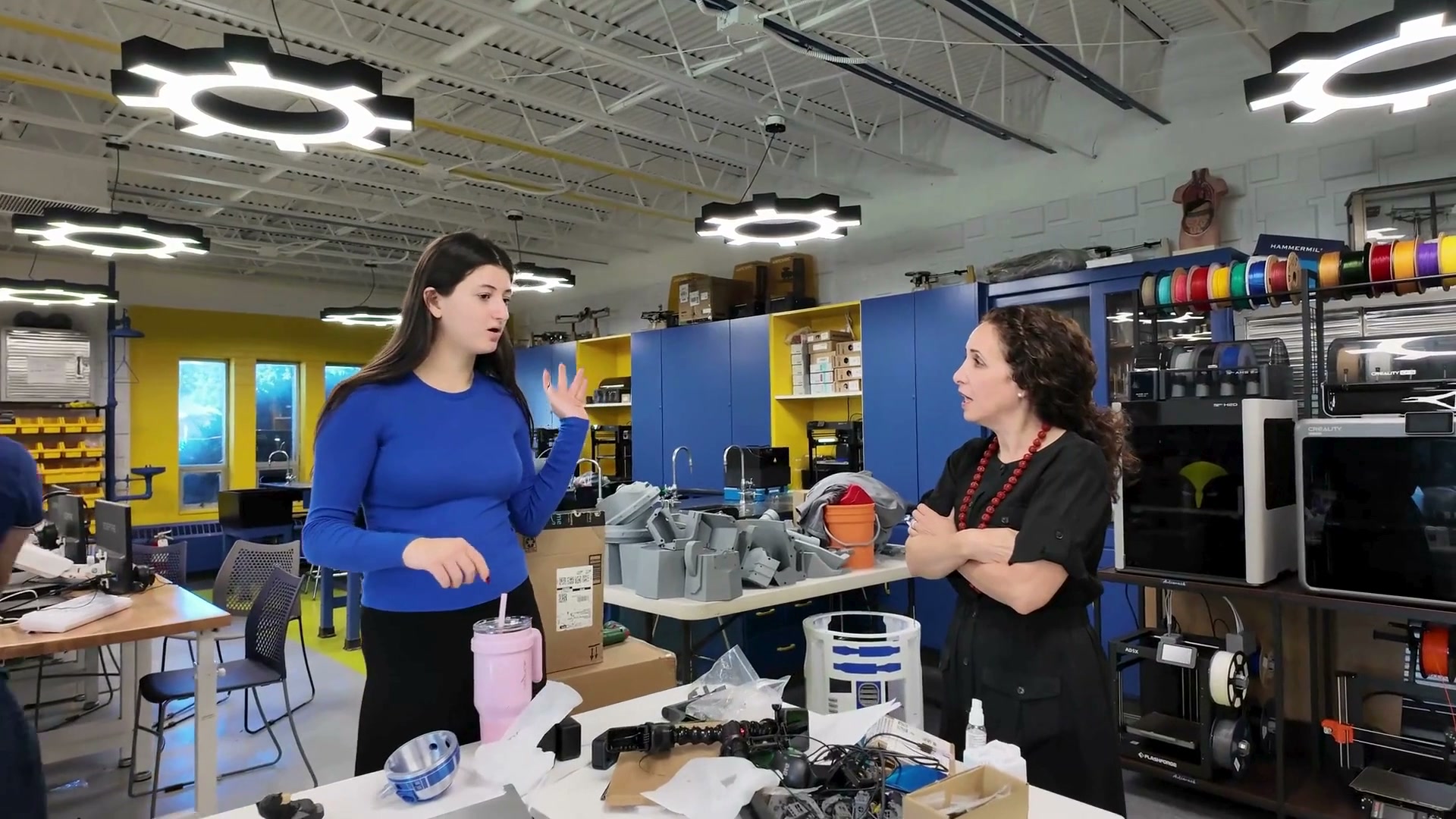
Hands-on STEM, 3D printing, and a robotics program competing at the very top: back-to-back VEX Robotics champions in 2024 and 2025, and championship finalists in 2026. The gear in our crest is no accident.
Dual Enrollment: real college credit in high school
Take a class you're already taking, and earn genuine college credit for it. Our teachers are certified by accredited universities such as St. John's University and Iona University, so by taking the class and doing well, you earn transferable college credit through that university, for a fraction of what the same credit costs later.
Up to 21 college credits
Depending on the courses you choose, you can graduate having already earned as many as 21 transferable college credits.
Real savings
An accredited head start for a small course fee now, instead of full college tuition for the same credits later.
A stronger college start
Arrive a semester or two ahead, with a lighter course load to protect your GPA, and earlier class registration at many universities.
Courses available for credit include English, History, Math, and Psychology.
The world is our laboratory
Our Science Department wants students to appreciate science and see its importance in their daily lives. Through hands-on discovery, and technology that brings the classroom to life, students study a broad range of scientific principles from 9th grade through AP. The full list of science courses is in the course catalog.

Labs in every course
Every science course is built around hands-on lab work, from the microscope skills students learn in 9th-grade Biology to evidence analysis in Forensic Science and inquiry-based labs in AP Physics. Students learn science by doing it.

Out in the field
Field trips are an integral part of the curriculum. From a short walk to the Long Island Sound on our own campus, to the DNA labs at Cold Spring Harbor Laboratory and the American Museum of Natural History, students are challenged to apply what they learn in the classroom to real-life scenarios.
Support for every learner
Unlocking a student’s potential is sometimes best done with support beyond the classroom. Guidance and college advisors also follow each student’s progress across all four years.
- Psychologists, social workers and learning specialists work with students from their first day through graduation
- Help managing homework, preparing for tests and planning long-term assignments
- Organizational and time-management skills, and keeping up with classwork
- Specialists act as liaisons between students, parents and teachers
- Support periods are built into each student’s own schedule: no pull-out program, no missed classes
- Students with an IEP may also receive skill-based support from the Mamaroneck School District
Learning that leaves the building
Some of the experiences our students have had:
- Environmental programs on our own waterfront with educators from the Maritime Aquarium of Norwalk
- Guest speakers including local government officials, Lauren Weiser of Sharsheret, J-teen representatives, and our own alumni serving in the IDF
- Documentary viewings at the Jacob Burns Film Center
- Holocaust memorial programs for the Westchester community
- Workshops on Israeli society and politics
- A Yom HaZikaron program with a group of trauma social workers from Israel
- Annual participation in the Celebrate Israel Parade on Fifth Avenue
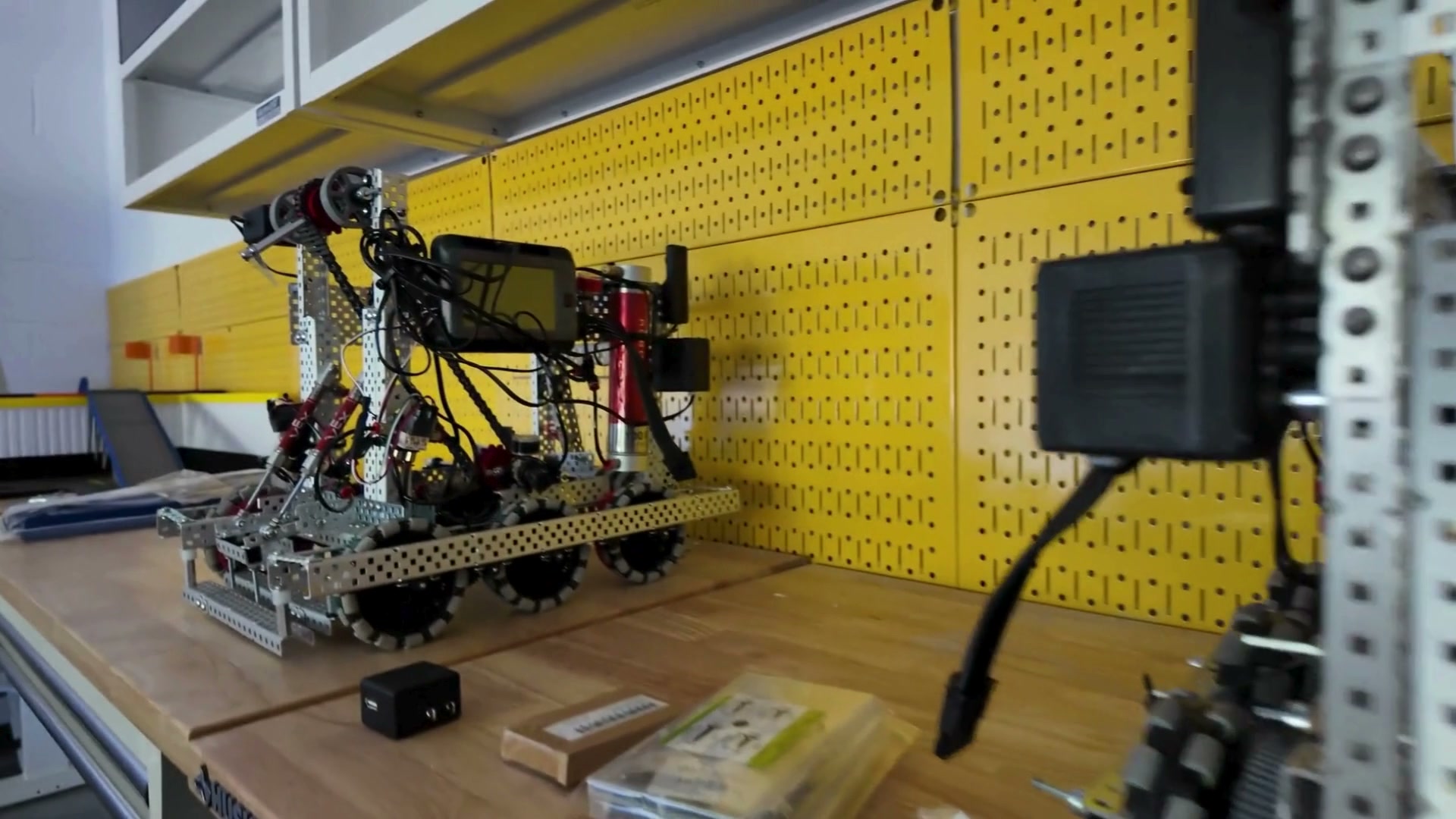
Champions. Champions again. And in 2026, all the way to the final.


Four years of guidance, year by year
Guidance at WHHS begins in 9th grade and changes with each student’s needs, all the way to graduation. We intentionally build a diverse college list, from the Ivy League and top-tier universities to fine arts schools, programs with academic support, SUNY and CUNY, and state universities beyond New York, always with an eye to an easy transition for observant Jewish students. We also help families plan for cost, including the FAFSA.
Explore and stretch
Guidance staff meet with freshmen in small groups and one-on-one, encouraging them to challenge themselves from the start, explore new areas of growth, and begin thinking about their academic and professional futures.
Aim high
Students learn what the PSAT, SAT and ACT are and why they matter. They are pushed to aim for the best and be the best: play a sport, organize a club, plan a chessed project.
Find the right fit
Pre-college preparation: exploring careers and the colleges that are “the right fit.” Parents are invited into the process, so everyone is on the same page and students feel less stress about this major stage.
Israel, college, or both
Applications, recommendations, college visits and, where appropriate, financial aid. Representatives from colleges and from Israeli yeshivot and seminaries present and interview right here on campus, and our College Night brings schools and families together.
Where our graduates were accepted
Classes of 2023–2026. Highlighted: schools our graduates chose to attend.
Their year in Israel
Classes of 2023–2026. Highlighted: programs our graduates chose to attend. Many receive college credit for part or all of their year.
See the academics in motion
Schedule a visit, sit in on a class across both curricula, and see what a small, personal school can do.